


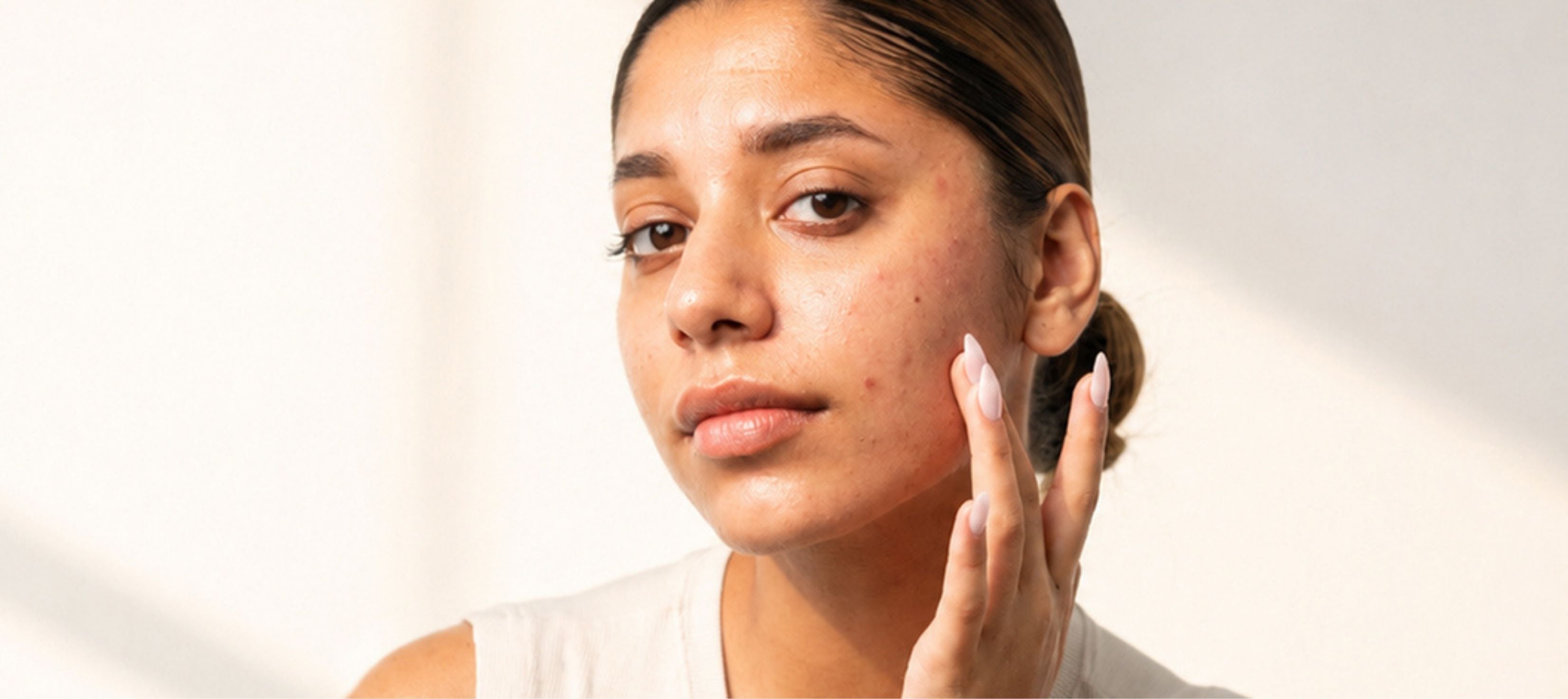
Why does summer heat cause sudden breakouts?
| 5 mins
Summer is supposed to be the fun season.
Vacations, pool days, sundresses, iced coffee. But for a lot of us, it's also the season where our skin just... loses it. Like, suddenly your skincare routine stops cooperating with you for no reason at all. Pimples start showing up - on the forehead, along the jaw, on the back… just everywhere.
I couldn’t even stop thinking about acne while trying to sleep, because with every small amount of sweat that crept on my face, I feared it turning into another acne. And, at the end, it was all just so annoying that it left me thinking, “Didn't I have this under control?”
But if you are also facing the same situation, let me assure you, you’re not alone. Summer acne is widely common, and there’s an actual science behind why it happens, which honestly made me feel a little less insane.
Let's break it down simply. I am hoping that my observations can prove helpful to as many people as possible.
First, Know You're Not Alone!
A study published in PMC found that among acne patients studied in India, more than 47% reported that their acne worsened with seasonal changes, and summer was the biggest trigger, with average temperatures around 32°C making things significantly worse.
And it is not just people with acne. Even the people with generally clear skin start breaking out once the heat kicks in. So let’s see what exactly is happening?
Why Your Skin is Freaking Out in Summer?
1. Heat makes your skin produce way more oil
This is a big one. Your sebaceous glands, the little guys responsible for producing skin oil (sebum), go into overdrive when temperatures rise.
A study published in the British Journal of Dermatology found that sebum production increases by nearly 10% for every 1°C rise in skin temperature. So if you step outside in 38°C heat, your skin is literally pumping out way more oil than it does in cooler weather. Which now explains why my face starts feeling greasy right after five minutes of stepping outside these days.
Not to mention, more oil equals more clogged pores, and hence more pimples. And from there, it’s basically a domino effect.
Another study on ScienceDirect 2025 cited similar results – at higher temperature (around 32°C), participants in a randomised crossover showed measurable increases in sebum production and inflammatory skin markers, and reported significantly greasier skin.
2. Sweat is getting into your pores
As much as I dislike it, sweating is actually a healthy process. It's like natural air conditioning for your skin. Moisture (sweat) is released onto the skin, and as it evaporates, carrying away excess body heat, it helps the body cool down.
But the downside? When you sweat, all that moisture mixes with your skin's natural oil, dead skin cells, makeup, and environmental grime, thus creating the perfect breeding ground for C. acnes, the bacteria responsible for inflamed pimples.
3. Your skin hates the Heat-to-AC cycle
This one surprises most people. Going back and forth between the hot outdoor sun and the cold air conditioning all day can actually trigger breakouts.
Here’s how it works: Sun exposure has a keratolytic effect, which means it speeds up the skin's natural shedding cycle. But as soon as you walk into a cool, air-conditioned room, that process slows down abruptly. The result? The dead skin cells that were in the middle of shedding end up just sitting on the skin, ultimately blocking your pores.
So, if you are someone who goes in and out of AC a lot, be it office, mall, or car, this could be one of the reasons you are getting clogged pore bumps that aren’t exactly full-grown pimples but aren’t just nothing either. If you know, you know!
4. The wrong sunscreen is sabotaging you
Yes, you heard that right. Your sunscreen could also be part of the problem because not all are made the same way.
Many of them contain comedogenic ingredients like heavy mineral oils or silicones. In the summer, when your pores are always dealing with extra sweat and oil, slathering on a pore-clogging SPF is obviously not the best thing to do.
This isn't new knowledge. A study published in the Archives of Dermatology back in 1982 tested 29 sunscreen formulations and found that nearly half of them were comedogenic, meaning they were actively causing clogged pores.
Talking about a more recent 2025 review in ScienceDirect on comedogenicity in cosmeceuticals confirmed that this still remains a concern today.
The fix definitely isn’t to skip SPF; it's to switch to a lightweight, oil-free, mineral-based formula.
5. What you eat in summer matters too
Ice cream at the beach. Cold coffee drinks. Fried snacks. We eat differently in summer, but it shows equally on our skin.
Research published in PMC found that foods that spike our blood sugar quickly are consistently associated with more acne. With the spike in the blood sugar, a hormonal chain that ramps up oil production also gets triggered.
Okay, so what would actually help you with summer acne?
Cleanse away the summer sweat - Use a gentle, oil-free face wash, especially on the days you are outside in the sun.
Switch to a lightweight hydration- Use a gel-based or water-based hydrating moisturiser and keep the heavy creams for winter.
Your sunscreen might be too heavy - The right sunscreen should protect your skin without making it feel heavy or greasy. Looking for “non-comedogenic” and “oil-free” formulas can really help during summer.
Don’t let sweat linger - Whether coming back from the gym, a walk, or from just being outside, try not to let the sweat sit on your skin.
Over-Scrubbing makes it worse - I understand that it might be tempting to scrub more in summer, but it does trigger more oil production. Once or twice a week is absolutely enough.
Are you sleeping on acne?- It might be a daunting process, but that overused pillowcase is doing you no good. It is collecting sweat, bacteria, and dead skin. Changing it twice a week is the best way to prevent more acne.
Hydration matters - Staying consistently hydrated can help your skin feel less oily overall.
The Bottom Line:
Summer pimples aren't a mystery, and they're definitely not your fault. It's a combination of biology (heat increasing sebum production), environment (humidity and bacteria), habits (the wrong sunscreen, sweating, diet shifts), and that annoying indoor-outdoor temperature cycle.
The good news? Most of it is fixable with small, consistent changes to your routine. You don't need a 12-step regimen; you simply need a smarter summer strategy.