


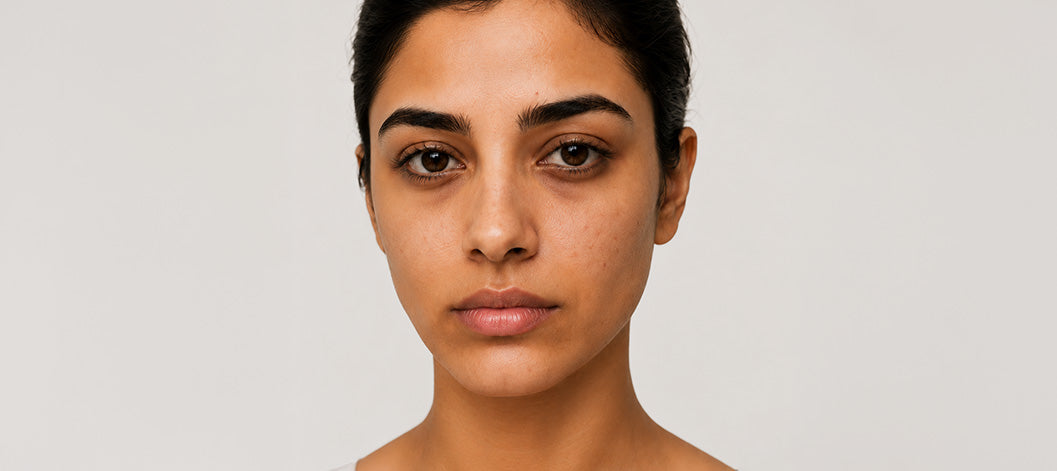
What happens to your skin when you're chronically sleep-deprived?
What does ‘chronic’ sleep deprivation actually mean?
Most people think sleep deprivation is just pulling an all-nighter. But chronic sleep deprivation is a lot more common and can be a lot more sneaky than you think.
It’s not that one day you didn’t (couldn’t) sleep right, but it’s about consistently sleeping less than your body actually needs. Five or six hours might feel "normal" after a while, but over time, this kind of deficit stacks up, and your skin notices the difference long before you do.
What happens to your skin when you are sleep deprived?
1. Your skin barrier starts to fall apart
Think of your skin barrier as a protective wall. Its job is to keep moisture in and irritants out, and sleep is critical to keeping that wall standing.
Research published in Clinical and Experimental Dermatology shows that poor sleep increases the transepidermal water loss (TEWL), which simply means your skin loses moisture faster than it should. Hence, leaving it dry, sometimes flaky and reactive.
A2019 PubMed study on Korean women found results stating that hydration dropped significantly just after one day of sleep deprivation, and it kept declining over a prolonged period of sleep restriction.
It's surprising how much of your skin's recovery depends on something as simple as getting enough sleep!
2. Collagen breaks down faster
This one's a big deal if you care about aging.
Collagen, a protein responsible for keeping your skin firm, bouncy, and smooth, takes a hit from two directions at once.
- It reduces collagen production - During deep sleep, our bodies release growth hormone, driving collagen synthesis. Less sleep directly means less growth hormone and collagen.
- It speeds up collagen breakdown - Poor sleep triggers your body’s stress response, causing a spike in cortisol, thus activating enzymes called matrix metalloproteinases (like collagenase) that literally break collagen down.
The result? Fine lines show up earlier. Skin loses its elasticity. And you start looking older than you are.
3. Inflammation goes up. Your skin shows it!
Sleep loss puts your immune system on edge, increasing inflammatory proteins throughout the body. And your skin takes the hit first. It may show as:
- Redness and puffiness
- Increased skin sensitivity
- Worsening of pre-existing conditions
4. Existing chronic skin conditions worsen
If you have acne, eczema, psoriasis, or rosacea, this part is especially for you.
A 2025 systematic review in ScienceDirect analyzed 117 observational studies and found that sleep disturbances consistently worsened conditions including urticaria, atopic dermatitis, psoriasis, rosacea, and acne.
Understand: it works both ways. Skin conditions can disrupt your sleep, and poor sleep can make those conditions worse. The loop, apparently, is really hard to break without addressing both.
5. Your skin tone, brightness and pigmentation change
Ever noticed your skin looked dull, uneven or just… off after a bad sleep? You're not imagining it.
A study published in Sleep Research (Wiley) found that sleep deprivation leads to measurable changes in skin, including less lightness, more pigmentation intensity, less transparency, more redness, and more prominent dark circles.
There is a lot of evidence out there indicating that sleep deprivation and circadian rhythm disruption affect skin pigmentation by influencing melanocytes (specialized cells in your body responsible for producing melanin) and hormonal balance.
The classic "you look tired" comment has also been scientifically validated.
How much sleep are you actually getting? And here's what it's doing to your skin
|
Hours of Sleep per night |
What your skin experiences |
|
7–9 hours |
Skin barrier stays intact, collagen production stays normal, inflammation is low, and complexion stays bright and even |
|
6 hours |
Mild dryness starts appearing on the face, skin recovery slows, there might be dullness by midday |
|
5 hours |
Alarming! Noticeable dullness on the face, puffiness and uneven tone, collagen breakdown increases, dark circles start to deepen |
|
4 hours or less |
Significant barrier damage, cortisol spikes (stress hormone), active collagen loss, inflammation spikes. Skin is visibly tired and aged. |
|
Chronically under 6 hours (weeks/months) |
High accelerated skin aging, worsened acne/eczema/psoriasis, persistent experience of dullness, reduced ability to bounce back from UV or external (environment and/or food) damage to the skin |
Can your skin recover from the damage?
Yes, but it takes time. Our skin does start to bounce back from the damage we might have done over a period of time, while not resting (sleeping) as we should. Once you consistently start getting 7 to 8 hours of sleep again, your skin slowly begins repairing itself.
What can you actually do about it?
- Protect your sleep: Even 30 minutes of scheduled sleep matters.
- Sleep in a cool, dark room: Melatonin (a natural antioxidant that protects skin) rises during dark, cool sleep.
- Don't just rely on skincare: No serum can fix what 5 hours of sleep does. Skincare only helps if you keep it balanced and managed.
- Stay consistent with your sleep: Our busy lives can very easily lead to forgetting what matters the most!
Final Words!
Every night, your skin gets to work - repairing itself. It rebuilds your barrier, supports collagen production, regulates inflammation, and recovers from everything it faced during the day.
Cutting sleep short means interrupting that process over and over again. The best skincare routine in the world can't fully replace what a good night's sleep does for your skin.