


The Hidden Impact of Water Pollution on Your Skin Barrier
| 4 minutes
Most mornings, I wash my face without thinking much.
The water comes from a tap I’ve trusted all my life. It is cool or warm (on demand), smells faintly of something ‘clean’, and disappears down the drain as obediently as it arrives.
This small ritual — splash, rub, rinse — feels so ordinary that it hardly seems like an interaction with the outside world.
Water, after all, is not supposed to be an exposure.
Only since I read about uranium in the groundwater of my city did I realise how much work that assumption has been doing.
The pollution we don’t dramatise
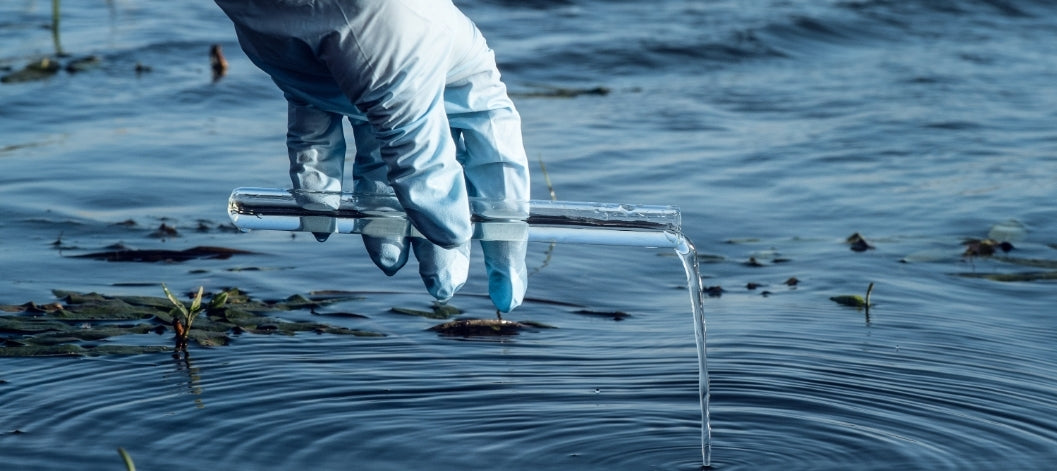
We tend to imagine pollution in obvious forms: oil slicks, smog, chemical spills. Those failures announce themselves. Tap water doesn’t.
It looks clear. It is regulated. It goes through tests.
By most definitions, it is safe until daily contact with water coincides with skin complaints like tightness, redness, irritation, a sense that the skin feels better when left alone than when ‘cleaned.’
What exactly does water do to our skin
To understand that, it’s important to reconsider our definition of human skin.
It is hard not to notice how capitalism has changed our relationship with skin. We think of it not as a living system but as a surface that should be polished, exfoliated, and corrected.
Biologically, skin (an organ) is the outermost layer functioning as a barrier. This barrier is a delicate structure made of lipids, proteins, and cells. Its job is not simply to keep dirt out, but to regulate what passes in and out of the body: moisture, irritants, microbes, chemicals.
When it works well, we don’t notice it. When it doesn’t, everything feels slightly off.
The problem with water and the skin barrier
Modern water systems weren’t designed with this barrier in mind. Their primary concern is ingestion.
Regional water is treated to kill pathogens that could make us sick if swallowed.
Chlorine and related disinfectants are effective at this task, which is why they are used almost universally.
Heavy metals and industrial contaminants are regulated based on how dangerous they are to consume in certain quantities.
From a public-health perspective, it makes sense.
However, skin encounters water more frequently, and it absorbs and reacts differently.
Chlorine, for example, does not linger on the skin in large amounts, but repeated exposure alters the pH and interferes with the lipids, keeping barrier intact.
Hard water (rich in calcium, magnesium, uranium) can bind to soap residues, leaving films that disrupt barrier function and increase irritation.
Trace metals, even at levels considered safe for drinking, can generate oxidative stress on the skin’s surface.
Real-time case studies in India
The consequences of neglecting the direct link between water and skin issues are evident.
People are adapting in small, personal ways.
They rinse less often. They switch cleansers. They apply thicker creams. Some install shower filters or wash their faces with bottled water.
However, not everyone has the same ability to do so. The effect of which can be seen in an increasing number of skin issues linked to water.
- A 2020 survey along the Ganga found nearly 90% of respondents had experienced at least one episode of disease, and this has only increased over the last 10 years.
- Chronic exposure to arsenic in drinking water in West Bengal, Bihar, and Uttar Pradesh leads to severe skin lesions (arsenicosis), and an increasing number of cases have been reported over the decades.
- About 37.7M Indians suffer from waterborne diseases annually due to inaccessibility to safe water.
The source of water contamination
Water quality in India largely depends on geography, age of plumbing, local regulation, and aggressive chemical treatment.
The biggest source, however, is untreated sewage discharged directly into water bodies.
Massive industrial discharges (heavy metals, chemicals) and extensive agricultural runoff (pesticides, fertilizers), compounded by poor infrastructure, rapid urbanization, weak regulation, and natural contaminants such as arsenic and fluoride, make most surface water unsafe and groundwater vulnerable.
These issues come together to form the massive foam of Yamuna (Delhi), the Lake of Fire (Bellandur Lake) in Bangalore, the uranium contamination in groundwater of Punjab, Noida, and Rajasthan.
The Way Ahead
None of the above suggests that we should stop washing, or that modern water systems are failures. On balance, they are among the greatest public-health achievements in history.
The problem is not that water is dangerous, but that our understanding of ‘safe’ has been too narrow.
I still wash my face every morning.
The ritual hasn’t changed. What has changed is my awareness that cleanliness is not a neutral act.
It reflects decisions made far from the sink, about infrastructure, regulation, and risk.
And perhaps that is the quiet lesson here: pollution does not always arrive as a crisis. Sometimes it arrives as clean water.