


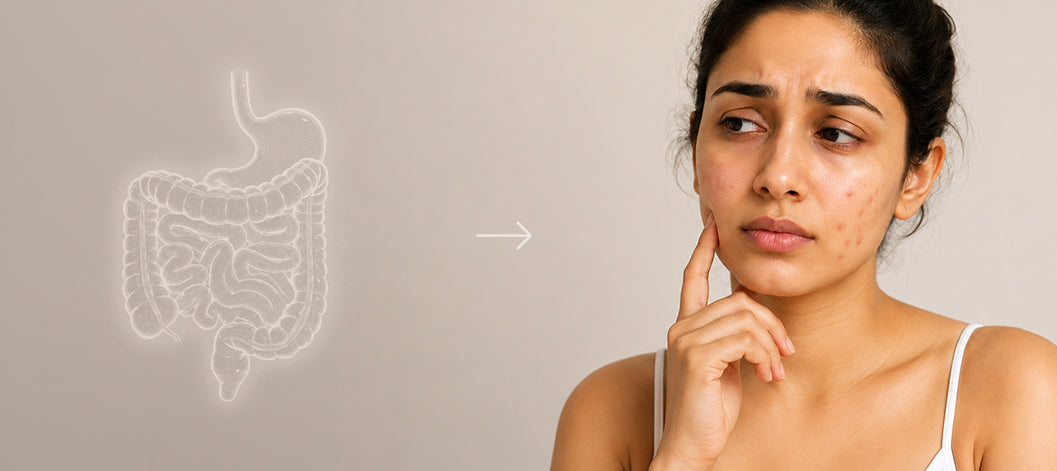
Skin-Gut Axis: Why is your gut health affecting your skin?
The Skin-Gut Axis: Why your gut health is literally on your face?
You've probably heard, "You are what you eat." A more accurate way to put it, at least when it comes to your skin, is that your face often reflects what's happening in your gut. And it's not just an opinion anymore. There's rapidly growing research behind it.
I used to think gut health and skincare belonged in completely different conversations. The more I read, the more I realised they're far more connected than I ever imagined.
And the connection even has a name: the gut-skin axis.
So, what actually is the gut-skin axis?
Think of your gut and skin as two organs constantly talking to each other through the immune system, bloodstream, and trillions of bacteria living in both places.
Research published on PubMed shows that your gut microbiome is a key regulator of the immune system, maintaining homeostasis (the body’s ability to maintain a stable, balanced internal environment like temperature, hydration, and sugar levels). When it's balanced, everything works as it should. But when it's disrupted, that imbalance can contribute to inflammatory skin conditions like acne, eczema and psoriasis.
Leaky Gut - Why your skin pays the price?
Your gut works like a filter between the food you eat and your bloodstream. Normally, it lets nutrients pass through while keeping harmful things out.
But when this lining becomes weak or irritated, something often referred to as “leaky gut”, tiny gaps can form in it. This allows unwanted substances, like toxins or bacteria, to slip into the bloodstream when they normally shouldn’t.
A PMC review explains it quite well: dysbiosis (a term used for the gut bacteria being out of balance) can lead the gut lining to be weakened and more “leaky”.
Once that happens, your immune system reacts by creating inflammation throughout the body, and your skin is often one of the first places where that inflammation shows up.
Which skin conditions are most linked to gut health?
Acne:
It is not just about oily skin or dirty pores. Research suggests that high carbohydrate and saturated fat intake disrupts gut signaling, promoting Propionibacterium (a common bacterium on the skin) acne growth, which may contribute to breakouts.
Rosacea:
People with rosacea, a condition that causes ongoing facial redness and sensitivity, are more likely to also have gut-related issues like bacterial overgrowth, stomach infections, or even inflammatory bowel problems.
This suggests that rosacea may not just be a skin issue. For many people, inflammation and imbalance inside the gut could also be playing some part in what’s showing up on their face.
Eczema & Psoriasis
A 2025 Tandfonline review, confirmed that when gut bacteria are out of balance (dysbiosis), it can weaken the body’s natural protective barriers and increase inflammation. That may in turn trigger or worsen skin conditions like eczema and psoriasis, leading to more frequent flare-ups.
Gut vs Skin: What's the connection?
|
What goes wrong in the gut |
What shows up on your skin |
|
Gut bacteria imbalance (dysbiosis) |
Increased inflammation causes acne, redness, flares |
|
Leaky gut / damaged gut lining |
Toxins enter bloodstream causing widespread irritation |
|
Low short-chain fatty acids (SCFAs) |
Less anti-inflammatory protection causes eczema, psoriasis |
|
Small Intestinal Bacterial Overgrowth (SIBO) or Helicobacter pylori overgrowth (infects the stomach lining) |
Linked to rosacea flares and persistent redness |
|
High sugar, high fat diet |
Feeds bad bacteria, disrupting skin microbiome |
So, now what fixes it and how to go about it!
Can probiotics actually fix it?
Short answer? Yes, probiotics can help, but they're not a magic fix.
How? Improving the balance of healthy bacteria in your gut may help calm certain skin problems.
Probiotics (good bacteria) and prebiotics (food that feeds those good bacteria)can support gut health, reduce inflammation in the body, and in some cases help improve skin conditions like acne, eczema, or rosacea.
1. For acne, the most common skin issue, a2025 review covered how improving gut health may also help improve inflammatory skin conditions. Studies found that people taking probiotic supplements saw a noticeable reduction in inflamed pimples and acne, compared to those taking a placebo.
2. Another study focused on rosacea indicated that using probiotics along with doxycycline treatment saw better improvements in redness, irritation, and inflammation. The study also noticed positive changes in gut bacteria, which were linked to healthier & better-looking skin.
Hence, probiotics aren't a cure. But the evidence that they support the gut-skin axis is real and has grown recently.
What to do to support your gut (and your skin)?
No complicated protocol needed. Start with the basics:
1. Eat more fibre
Vegetables, legumes, and whole grains feed the good bacteria that produce anti-inflammatory SCFAs (short-chain fatty acids, the metabolites produced by gut bacteria fermenting dietary fibre).
2. Cut down on sugar and ultra-processed food
These are directly disrupting your gut microbiome balance and showing on your skin.
3. Try adding a probiotic to your routine
Especially with Lactobacillus and Bifidobacterium strains, since they have the most evidence behind them for skin-related outcomes.
4. Take gut symptoms seriously
Bloating, irregular digestion, and skin flares often travel together.
5. Be patient
The microbiome takes weeks to shift. Stick with the routine!
The bottom line
Simply put, our skin and gut are more connected than most people realize. The gut-skin axis is the connection between the two, where changes in gut health can influence inflammation, immunity, and ultimately, your skin.
If you've been throwing products at a skin problem that keeps coming back, it might be worth asking a different question: what's going on in your gut?