


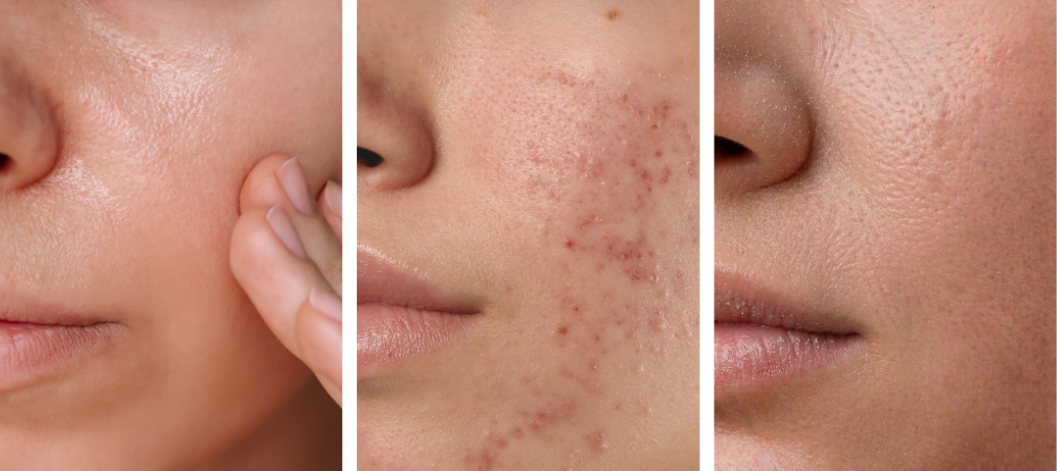
Oily, acne-prone & dehydrated: The most confusing skin type explained
| 5 mins
There’s a specific kind of frustration that comes with watching your forehead shine like glass under sunlight… while your cheeks feel like they’re two sizes too small.
It’s the kind of skin confusion that makes you buy oil-control cleansers in the morning and heavy hydrating serums at night and annoyingly so, somehow still wake up with a new breakout.
I remember sitting with my friend listening to her rant about how her skin “couldn’t decide what it wanted.”
By lunchtime she looked oily. Ten minutes after washing her face, she felt tight and dry. She kept switching products, mattifying gels, clay masks, acne treatments and whatnot!
But what is the full story? —
What she and many people experience is something far more nuanced, where skin like that is oily, acne-prone and dehydrated at the same time.
It sounds contradictory, almost impossible. Yet dermatological research shows this combination is not only real, it’s more common than we think.
Understanding this paradox is the first step toward breaking the cycle of over-cleansing, over-treating, and under-hydrating.
Let's see how we can do that for you and understand what is happening beneath the surface.
Understanding the paradox: How oily skin can also be dehydrated?
At first glance, “oily” and “dehydrated” seem like opposites, one suggests excess oil, the other lack of water. Yet, these two can coexist.
Which means OIL IS NOT EQUAL TO HYDRATION!
The oil your skin produces (sebum) and the water levels in your skin are completely different things. Sebum is a lipid (oil based) substance, hydration refers to the water levels in the skin cells. So, even if your skin looks oily, it can still indeed be lacking water, which is known as skin dehydration.
Our skin loses water through the outer layer (a process called trans-epidermal water loss (TEWL) and then it tries to compensate.
That compensation unfortunately often comes in the form of increased sebum production.
Think of a plant sitting in the sun. If you forget to water it, the soil becomes dry and cracked.
Now imagine trying to “fix” it by spraying oil on the leaves instead of giving it water. The leaves might look shiny for a while, but the plant is still dehydrated at its roots.
That’s exactly what happens with oily, dehydrated skin. Your skin is lacking water deep down, but instead of producing water (which it cannot), it produces more oil. The surface looks shiny, sometimes even greasy, but underneath, the skin cells are still thirsty. The oil is just a protective reaction, not real hydration.
This paradox has been widely discussed in the dermatological world of skin hydration and barrier function.
Why oily & acne-prone skin often has barrier issues
Acne is not just about excess oil, it is an inflammatory problem of the hair follicle and oil gland unit. Research shows that people with acne have differences in their skin barrier, including higher water loss (TEWL) and lower hydration levels, compared to those without acne.
In simpler terms, your skin is letting too much water escape >> resulting in your oil glands reacting by producing more sebum >> further that sebum mixes with debris and dead skin cells >> ultimately, the skin gets clogged, inflammation rises >> hence, the ACNE!
How to know if you're oily + dehydrated + acne prone
Here are the tell-tale signs of this confusing but real skin type:
1. Your face looks shiny but feels tight
Right after washing you might feel dry, tight, or “pulling,” even though you produce oil later in the day.
2. Breakouts persist despite excessive oil control
If stripping oils hasn’t prevented acne, dehydration could be contributing to pore blockage and inflammation.
3. Skin flakes under makeup even in oily zones
Dehydrated skin can look flaky in areas where oil is expected. This is dehydration, not dryness.
4. You can’t tell true skin type at any point
Many people with this combination can’t decide if their skin needs more hydration or less oil, because often it needs both, but a little differently.
What causes this tricky skin combination
1. Over-cleansing and harsh products
2. Environmental stressors (sun pollution, heat and even air conditioning)
3. Hormones and genetics (yes, during periods, PCOS or puberty, there is an increase in sebum production, even if your skin is hydrated)
4. Diet and lifestyle (lower water intake, high sugar/caffeine/processed foods or poor sleep)
And finally, how to treat this condition efficiently, without breaking your bank
Focus on barrier repair first – Not oil control
This might sound counterintuitive, but when your barrier is weak, your skin overcompensates by producing oil, which leads to breakouts and inflammation.
And what helps you repair the skin barrier?
Ceramides, Fatty Acids & Cholesterol (these are main building blocks of a strong skin barrier)
Hyaluronic Acid, Glycerin (they attract moisture and help your skin stay soft and plump)
Use lightweight, non comedogenic moisturizers
Contrary to myth, oily skin still needs moisturizer. Studies show that using products that support the skin barrier helps with acne and paradoxically oily conditions.
Add actives skincare ingredients, but wisely
Salicylic acid and benzoyl peroxide can help unclog pores and reduce acne, but don’t overuse them. Over-exfoliation can worsen dehydration and disrupt the barrier further. Start may be once a week.
Protect from sun & environmental stress
UV damage increases water loss and worsens oil imbalance. Always use a lightweight, non-comedogenic sunscreen suited to oily skin.
Cleanse Gently – But Not Too Much
Cleansing twice a day with a mild, pH-balanced, sulfate-free cleanser helps remove unwanted sebum without disrupting the barrier. Over washing your face will strip water and oils, making the skin produce more oil.
Takeaway:
- Oil production is not a sign of moisture level.
- Barrier dysfunction contributes significantly to acne and dehydration.
- Gentle hydration and barrier support can reduce oil, resulting in breakouts.