


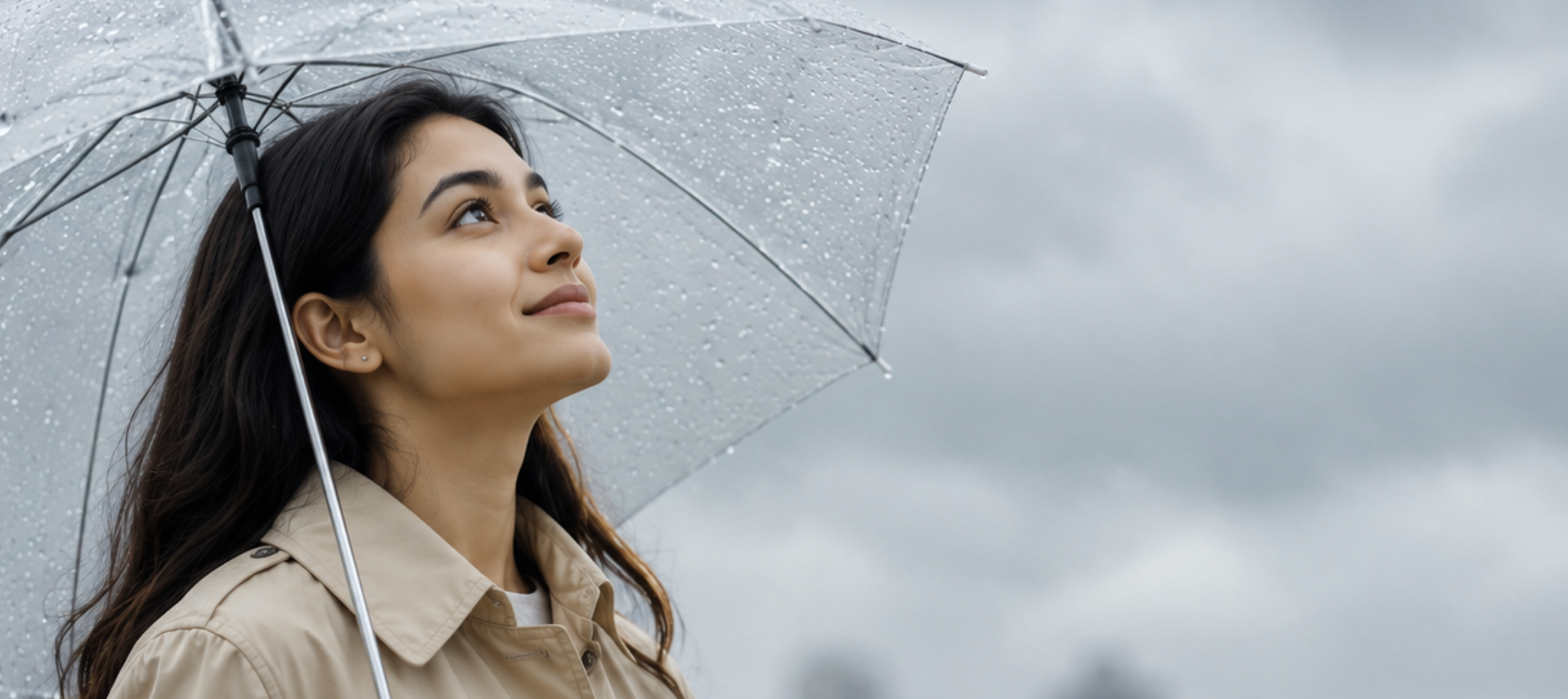
Is Sunscreen necessary on Cloudy & Rainy Days?
We usually associate sunscreen with bright, sunny days, so a cloudy sky can make it feel unnecessary.
We assume there is less sunlight, the temperature is lower, and during heavy rain, the sun may not even be visible. But in reality, less visible sunlight does not mean your skin is free from UV exposure.
So, is sunscreen necessary when the sun is not visible, hidden in clouds?
If you are going outdoors during the day, then the answer is an absolute YES. Clouds can only reduce some UV radiation, but they do not block it completely. The World Health Organization notes that up to 80% of solar UV radiation can pass through light cloud cover.
So, what matters is not whether you can see the sun, but how much UV exposure is reaching your skin.
Remember! Cloudy doesn't mean UV-free
Think of clouds as a filter, not a complete shield.
Clouds can reduce some UV radiation, but they do not block it completely. This is why you might sometimes develop a sunburn even if it feels chilly or overcast.
There is another reason cloudy days can be misleading: you cannot feel UV radiation.
The warmth you feel on a sunny day is largely associated with infrared radiation, not UV radiation.UV radiation does not produce the same noticeable heating sensation.
Myth: “If I can't see the sun, I don't need sunscreen.”
Fact: UV radiation can still reach your skin through clouds, so sun protection still matters when you are outdoors.
What happens to your skin without protection?
Sunscreen isn’t just about preventing tanning.
Repeated exposure to UV radiation can ultimately contribute to:
1. Sunburn
2. Premature skin ageing
3. Dark spots and uneven pigmentation
4. Worsening of some pigmentation conditions
5. Increased risk of skin cancer
Broad-spectrum sunscreen is the one that protects you against both UVA and UVB radiation. UVA is strongly associated with photoageing and pigmentation, while UVB is the main cause of sunburn.
If you deal with acne or acne marks, sun protection is particularly important because UV exposure can make dark marks darker or more persistent.
The American Academy of Dermatology found that sunscreen can help reduce the risk of dark spots appearing after inflammatory skin conditions such as acne.
What about a really rainy day?
This is where some nuance is needed.
On a heavy rainy day when you are staying indoors with no outdoor daylight exposure, your need for sunscreen is different from a day when you are spending several hours outside.
But if you are:
1. Travelling to work
2. Walking outdoors
3. Sitting outside
4. Driving
5. Commuting on a two-wheeler
6. Running errands
7. Going for a morning walk
you are still being exposed to daylight and UV radiation.
So rather than using “Is it sunny?” as your deciding factor, a more useful question is:
“Will I be exposed to daylight outdoors?” It’s as simple as that.
If the answer is yes, sunscreen should be a non-negotiable part of your daytime skincare routine.
Does rain wash sunscreen away?
It can.
Rain, sweat, wiping your face, and water exposure can reduce the sunscreen film on your skin. This is why a water-resistant sunscreen can be practical during wet or humid seasons.
However, “water-resistant” does not mean waterproof. If you are sweating heavily or getting wet, check your sunscreen's directions and reapply as needed.
Which type of sunscreen is the best for cloudy and rainy weather?
If your current sunscreen works well for you, you don't need to switch to a completely different one just because it's monsoon.
If you're choosing a sunscreen, look for:
Broad-Spectrum Protection
This protects against both UVA and UVB rays.
SPF 30 or Higher
The AAD recommends SPF 30 or higher for adequate everyday protection.
Water Resistance
Especially useful if you live somewhere humid, sweat frequently, or spend time outdoors during rainy weather.
A Texture You Will Actually Use
If a sunscreen feels sticky and is uncomfortable, you can reconsider a different variety. Suggested options are a lightweight gel, lotion, or fluid, which may feel more comfortable for some people, particularly in humid climates.
If you have acne-prone skin, you can also look for products labelled non-comedogenic.
How much sunscreen should you apply?
Using sunscreen is only helpful if you apply enough.
The AAD recommends approximately 1 ounce (around a shot-glass amount) for the exposed areas of an average adult's body.
For everyday facial application, many people find the two-finger method easier to follow: applying a line of sunscreen along the length of the index and middle fingers for the face and neck.
The exact amount can vary with hand size and how much skin you are covering, so the main point is simple: don't apply such a thin layer that you barely notice it.
When should you reapply?
You don't necessarily have to reapply sunscreen simply because two hours have passed if you are indoors and away from direct daylight exposure.
If you're outdoors, reapply approximately every two hours, and sooner after swimming or significant sweating.
Your Monsoon Sunscreen Checklist
Before heading outside on a cloudy or rainy day, ask:
1. Am I going to be outdoors during daylight?
2. Is my sunscreen broad-spectrum?
3. Does it have SPF 30 or higher?
4. Will I be sweating or exposed to rain?
5. Have I applied enough?
6. Will I need to reapply because of prolonged outdoor exposure, sweating, or rain?
If most of these answers point toward outdoor exposure, there is no reason to skip sunscreen simply because the sky is grey.
The Bottom Line
Yes, sunscreen still matters on cloudy and rainy days when you're spending time outdoors. UV radiation can pass through clouds, even when the sun isn't visible.